Previous
Next
Answers to common questions about ONYDA XR - mother and son with homework

Answers to common questions about ONYDA XR

A Caregivers' Practical Resource Booklet Icon

Learn more in our patient brochure

Find answers to common questions about ONYDA® XR (clonidine HCl)

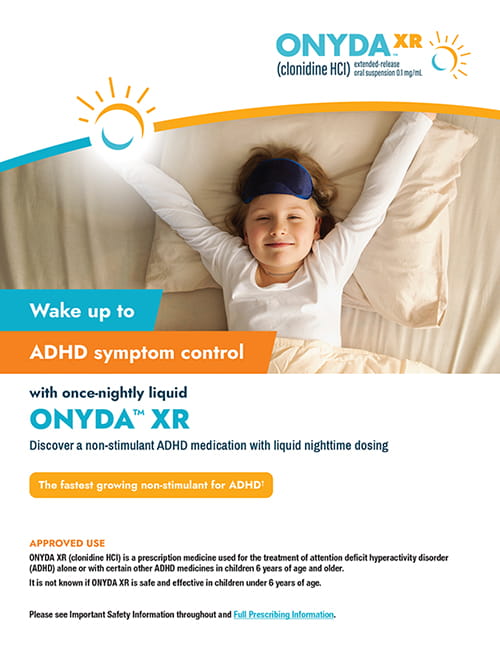
ONYDA XR is a once daily, nighttime-dosed, liquid non-stimulant medication approved to treat ADHD in children 6 years and older.

ONYDA XR contains clonidine hydrochloride (HCl), a medication that has been used in pediatric care for decades.

Clonidine belongs to a class of medications called alpha-2 agonists, which means it stimulates specific receptors called alpha 2 receptors, including 2A, 2B, and 2C receptors in the brain.

These Alpha-2 receptors have different locations and effects in the brain: 2A and 2C receptors are found widely in the brain, including the prefrontal cortex (PFC). The PFC has a role influencing attention, movement and impulsivity, which are affected in ADHD. 2B receptors are mostly in the thalamus, which along with 2A and 2C receptors in the locus coeruleus, could contribute to the sedating effect of clonidine.

Clonidine regulates the release of norepinephrine, a neurotransmitter that acts as a signaling messenger. Norepinephrine has many effects in the body. Its effects related to ADHD in the central nervous system influences cognition and behavior. Clonidine strengthens the connection of brain networks in the prefrontal cortex, so parts of the brain can communicate when doing different functions or tasks.

Clonidine comes in different formulations, including extended-release tablets, and extended-release oral suspension, as ONYDA XR. Although not approved by the FDA to treat ADHD, immediate-release clonidine is sometimes used off label for this purpose.

Tris Pharma developed ONYDA XR for ADHD patients, with its proprietary LiquiXR® technology. LiquiXR technology is designed to provide patients with a smooth continuous release of clonidine throughout the day.

Ion-Exchange: Clonidine is released when positively charged ions within the digestive system diffuse through the coating, and exchange with clonidine. Subsequently, the clonidine diffuses out of the coating to be released into the gastrointestinal (GI) tract. Clonidine continuously releases regardless of food, pH, metabolism of the drug, or the location within the GI tract.

Diffusion: Each dose contains a mixture of immediate- and extended-release particles. Immediate-release particles are not coated and release the clonidine quickly. Extended-release particles are coated with a protective layer. The particles with thinner coatings release the medication sooner, while those with thicker coatings take longer for medication to release, creating a sustained and continuous release.

This advanced technology combines ion exchange and diffusion to deliver clonidine continuously, creating a smooth pharmacokinetic profile. LiquiXR advances what extended-release ADHD medications can achieve — delivering ADHD symptom control through the day with just one daily dose.

Watch this video on how LiquiXR releases medication.

ONYDA XR is manufactured exclusively in Monmouth Junction, New Jersey, USA. Tris Pharma oversees the development, manufacturing, quality control, quality assurance and distribution of ONYDA XR across America, helping ensure consistent product quality. Every batch of ONYDA XR undergoes FDA-regulated quality standards before distribution to patients.

My child is unable to swallow pills or tablets
ONYDA XR is a once-daily extended-release liquid medication that may be a helpful option for children who have difficulty swallowing pills or tablets. The liquid formulation can simplify administration for caregivers while providing all-day symptom control without the need for additional dosing during school hours.

My child needs an alternative to stimulants
For children who need an alternative to stimulant medication, ONYDA XR offers a non-stimulant treatment option to discuss with your child’s healthcare provider. ONYDA XR has been shown to reduce ADHD symptoms and may be considered based on a child’s medical history, treatment experience, and individual needs.

My child takes a stimulant but needs additional symptom coverage
If ADHD symptoms remain challenging despite treatment with a stimulant medication, ONYDA XR may be used as an add-on therapy. A healthcare provider can help determine whether adding ONYDA XR may support a child’s overall treatment goals and symptom management needs.

My child needs precise, individualized dosing
Because ONYDA XR is a liquid medication, healthcare providers can make small, individualized dose adjustments based on how a child responds to treatment. This flexibility may be helpful for children who are sensitive to medication effects or who require a more customized dosing approach.

My child is newly diagnosed with ADHD and we are exploring treatment options
Families who are beginning to evaluate ADHD treatments may wish to discuss ONYDA XR with their healthcare provider. Decisions about treatment should consider the benefits and risks of available options and be tailored to the needs of the child and family.

My child’s ADHD symptoms are difficult to manage in the mornings and evenings
Some children experience ADHD symptoms before morning medication takes effect or after daytime medication begins to wear off. Taken once nightly, ONYDA XR is designed to provide continuous clonidine release.

Clinical Studies

The efficacy of ONYDA XR is based on two 8-week studies of clonidine XR hydrochloride extended-release tablets in pediatric patients aged 6 to 17 years who had confirmed ADHD according to DSM-IV criteria.*

Monotherapy study:

In a placebo-controlled, fixed dose, monotherapy trial, 236 pediatric patients (6-17 years of age) were randomly assigned to one of three groups: 0.2 mg of clonidine XR daily (n=78), 0.4 mg of clonidine XR daily (n=80), or placebo (n=78).

The clonidine XR dose was increased weekly until each patient reached their assigned dose. Patients were maintained at their dose levels for a minimum of 2 weeks before being gradually tapered down to 0.1 mg/day at the last week of treatment. Each week, researchers measured changes in the child’s hyperactivity/impulsivity and inattention using a standard ADHD rating scale (ADHD-RS-IV).

At week 5 (primary endpoint), patients receiving clonidine XR showed significantly greater improvements in core ADHD symptoms, such as hyperactivity, impulsivity and inattention, from baseline compared with the placebo group (as measured by the ADHD-RS-IV total score). As a monotherapy, clonidine XR began working as early as Week 1 in the 0.2 mg/day group.

Clonidine XR demonstrated significant symptom improvement as monotherapy, with marked behavioral improvements in inattention, hyperactivity and impulsivity from week 2 through the study.

The most common adverse reactions included somnolence, fatigue, irritability, pharyngolaryngeal pain, increased body temperature, insomnia, ear pain, emotional disorder, nightmares, constipation, and dry mouth.

To read the study, please click this link, “Clonidine extended-release tablets for pediatric patients with attention-deficit/hyperactivity disorder”.

Combined with stimulants:

In an 8-week, randomized, double-blind, placebo-controlled, flexible-dose trial of pediatric patients aged 6 to 17 years (n=198), patients receiving clonidine XR plus a stimulant were evaluated against placebo plus a stimulant, with the primary efficacy endpoint assessed at Week 5.

This study selected pediatric patients with ADHD who had been treated with a stimulant (methylphenidate or amphetamine) for four weeks with an inadequate response.The patients were randomly assigned to one of two treatment groups: stimulant + clonidine XR (n=102), or stimulant + placebo (n=96).

The clonidine XR dose was titrated until each patient had reached their individualized effective dose. Each week, researchers measured changes in the child’s inattention and hyperactivity/impulsivity, using a standard ADHD rating scale (ADHD-RS-IV). After week 5, the dose was gradually reduced by 0.1 mg/week.

From weeks 2 through 7, pediatric patients with stimulant + clonidine XR group significantly improved ADHD symptoms from baseline compared with the stimulant + placebo group.

In this study, pediatric patients who added clonidine XR to their stimulant medication experienced greater improvement in ADHD symptoms than those who received a stimulant and placebo. At 5 weeks of treatment, the ADHD-RS-IV Total Score improved from baseline by 15.7 points in the stimulant + clonidine XR group compared with 11.5 points in the stimulant + placebo group, representing a 37% greater improvement with combination therapy.

The most common adverse events in the study were somnolence, headache, fatigue, upper abdominal pain, nasal congestion, pharyngolaryngeal pain, cough, irritability, insomnia, increased body temperature and dizziness.

To read the study, please click this link: “Efficacy and Safety of Extended-Release Clonidine Hydrochloride for Attention Deficit Hyperactivity Disorder in Chinese Children and Adolescents: A Multicenter, Randomized, Double-Blind, Placebo-Controlled Trial”.

ONYDA XR FDA approval

On May 24, 2023, the FDA approved ONYDA XR (clonidine hydrochloride) extended-release oral suspension for treatment of attention-deficit/hyperactivity disorder (ADHD) as monotherapy or as adjunctive therapy to stimulant medication.

ONYDA XR vs. Clonidine XR

Active ingredient: Clonidine XR tablets and ONYDA XR both contain the same active ingredient: clonidine hydrochloride.

Formulation: Clonidine XR is a tablet. ONYDA XR is an orange-flavored oral suspension (liquid).

Administration with food: Both ONYDA XR and clonidine XR tablets can be taken with or without food. Clonidine XR tablets need to be swallowed whole. Tablets must be swallowed whole and never crushed, cut or chewed, or the release of the medication can be affected.

Release technology: Clonidine XR tablets contain clonidine combined with cellulose ethers, as hydroxypropyl methyl cellulose in a stable matrix which allows the release of clonidine over a 12 hour period. ONYDA XR uses LiquiXR which uses ion-exchange resin particles coated with polymer. This technology, as an oral suspension, allows a continuous release of clonidine and enables once-nightly dosing for children.

Pharmacokinetic (PK) curve: A PK curve shows how much medicine is available in the blood from the time it is taken until it wears off. In a crossover PK study in healthy adults, ONYDA XR was administered once at night and demonstrated a single peak in plasma clonidine concentrations (median Tmax 7.5 hours), whereas clonidine XR tablets administered twice (once at night, once during the day) produced two concentration peaks corresponding to each dose.

ONYDA XR provided comparable overall clonidine exposure and bioavailability (approximately 96.1%) to clonidine XR tablets, supporting once-daily dosing while maintaining similar systemic drug exposure.

ONYDA XR is administered at bedtime and produces a single peak in clonidine, typically while the child is asleep. Since clonidine XR tablets can be dosed twice daily, its PK curve may produce two peaks per day.

Dosing: The dosing for clonidine XR tablets starts at 0.1 mg at bedtime and is increased at 0.1 mg/day per week, with the doses taken twice a day. The higher dose tablet is taken at bedtime. ONYDA XR is taken once per day in the evening. ONYDA XR and clonidine XR tablets have the same dosage ranges from 0.1 mg/day to 0.4 mg/day. Both medications need to transition off the drug gradually to prevent high blood pressure from abruptly stopping the drug.

Similarities: Clonidine XR tablets have many similarities to ONYDA XR, including:

  • both have the same active ingredient: clonidine hydrochloride;
  • both do not have boxed warnings;
  • both can be used as a monotherapy or combination with a stimulant;
  • both can be taken with or without food;

Differences: Clonidine XR tablets have some differences to ONYDA XR, including:

  • ONYDA XR is an orange-flavored liquid, clonidine XR are tablets;
  • ONYDA XR is dosed once per night, clonidine XR may be dosed twice per day;
  • ONYDA XR uses LiquiXR technology, clonidine XR uses cellulose matrix to release medication;
  • ONYDA XR and clonidine XR tablets have different PK profiles;

Talk to your child’s healthcare provider to find the best option to treat their ADHD symptoms.

ONYDA XR is an orange-flavored liquid, taken by mouth once daily in the evening.

ONYDA XR can be taken at bedtime, with or without food. It is supplied in a 30 mL bottle and includes a press-in bottle adapter and an ONYDA XR oral dosing dispenser.

Caregivers should use only the ONYDA XR oral dosing dispenser to measure and administer each dose. Using other syringes, measuring devices, cups, or transferring the medication to another container may result in inaccurate dosing.

Take ONYDA XR exactly as prescribed by your doctor and as instructed by your pharmacist.

Storing ONYDA XR: Store ONYDA XR at room temperature between 68°F to 77°F (20°C to 25°C). Protect from light and keep ONYDA XR in the original container. Tightly close the child-resistant cap. ONYDA XR does not need to be refrigerated.

Disposing of ONYDA XR: Throw away any unused or expired ONYDA XR in your household trash. Throw away (discard of) any remaining ONYDA XR if you have not used it 30 days after first opening the bottle.

Keep ONYDA XR and all medicines out of the reach of children.

Yes, some healthcare providers may be able to offer samples of ONYDA XR for your child to try before writing a full prescription. Availability can vary by provider and clinic, so it’s best to ask directly during your appointment. If samples are available, they may help your provider assess how your child tolerates the medication and how it fits into daily routines before moving forward with a prescription.

Access and Coverage

Yes, Tris Pharma offers a Savings Card for ONYDA XR. Eligible families with commercial insurance may be able to reduce their out-of-pocket costs using the Tris Savings Card. Qualified patients may pay as little as $25 per month for ONYDA XR, depending on eligibility and program terms. Medicare and Medicaid patients may benefit from savings programs provided through their state-based insurance programs. A cash pay option is also available.

You can learn more about current eligibility criteria, enrollment, and support resources by visiting the ONYDA XR Savings & Support page. Because savings programs can change and may not apply to all insurance types (such as government funded plans), it’s a good idea to review the details online or ask your child’s healthcare provider or pharmacist for help navigating options.

Coverage for ONYDA XR varies by insurance plan. Some plans may require prior authorization, step therapy, or higher copays. Step therapy is an insurance process that asks patients to try certain lower-cost medications before approving coverage for a brand-name treatment. If you and your child’s healthcare provider believe ONYDA XR is the right option and that step therapy may not be appropriate, your provider can submit a letter of medical necessity to request coverage from your insurance company.

Savings & Support

We want to make getting ONYDA XR as easy and inexpensive as possible! Learn about your options below!

ONYDA Savings card
Eligible patients pay $25 per month with the Tris Savings Program

8 out of 10 of commercially covered patients pay $25

Get Savings Card

Or text TRIS to TRIS4U (874748) for a Mobile Savings Card§

ScriptsRX Logo
Eligible commercially-insured patients
pay as little as $15

You’ll also receive free delivery, automatic refills, same-day processing, and ongoing support.

Learn More

Stay in the know with all things ONYDA XR

Join the ONYDA XR Community to receive monthly emails about ONYDA XR and resources to help support your child's ADHD treatment journey.

REFERENCES: 1. Jain R, Segal S, Kollins SH, Khayrallah M. Clonidine extended-release tablets for pediatric patients with attention-deficit/hyperactivity disorder. J Am Acad Child Adolesc Psychiatry. 2011 Feb;50(2):171-9. 2. Kollins SH, Jain R, Brams M, Segal S, Findling RL, Wigal SB, Khayrallah M. Clonidine extended-release tablets as add-on therapy to psychostimulants in children and adolescents with ADHD. Pediatrics. 2011 Jun;127(6):e1406-13.

BACK TO TOP arrow up

Important Safety Information

ONYDA XR is a prescription medicine used for the treatment of Attention Deficit Hyperactivity Disorder (ADHD) alone or with certain other ADHD medicines in children 6 years of age and older.

It is not known if ONYDA XR is safe and effective in children under 6 years of age.

See Additional Important Safety Information.

APPROVED USE

ONYDA® XR (clonidine HCI) is a prescription medicine used for the treatment of Attention Deficit Hyperactivity Disorder (ADHD), alone or with certain other ADHD medicines, in children 6 years of age and older. It is not known if ONYDA XR is safe and effective in children under 6 years of age.

Important Safety Information

Do not take ONYDA XR if you are allergic to clonidine.

Before taking ONYDA XR, tell your healthcare provider if you have kidney problems; low or high blood pressure; a history of passing out (syncope); heart problems (including slow heart rate or rhythm problems); had a stroke or stroke symptoms; or had an allergic reaction after taking clonidine through the skin (patch). Tell your healthcare provider if you are pregnant, planning to become pregnant, or breastfeeding. It is not known if ONYDA XR may harm an unborn baby. ONYDA XR passes into breast milk and may cause sleepiness, floppy muscles, or breathing problems in breastfed babies. A pregnancy registry is available at 1-866-961-2388 or womensmentalhealth.org/adhdmedications.

Tell your healthcare provider about all medicines you take, including prescription and over-the-counter medicines, vitamins, and herbal supplements. ONYDA XR may interact with medicines for depression, ADHD, heart or blood pressure conditions, medicines that cause sleepiness, or other clonidine-containing medicines.

What to avoid while taking ONYDA XR?

Avoid dehydration and overheating, which may increase the risk of passing out.

Do not drive, operate machinery, or perform dangerous activities until you know how ONYDA XR affects you, because it may cause sleepiness and tiredness that can slow reaction times.

Avoid alcohol or other medicines that cause sleepiness or dizziness unless discussed with your healthcare provider.

Do not suddenly stop ONYDA XR. Stopping suddenly may cause rebound high blood pressure and withdrawal symptoms. Contact your healthcare provider before stopping treatment. If vomiting prevents you from taking ONYDA XR, contact your healthcare provider because rebound hypertension may occur.

Possible side effects

ONYDA XR may cause serious side effects including:

Low blood pressure and slow heart rate, which may increase the risk of passing out. Your healthcare provider should check your heart rate and blood pressure before and during treatment.

Sleepiness and tiredness that may slow reaction times.

Rebound high blood pressure and withdrawal symptoms after sudden stop (including headache, increased heart rate, nausea, flushing or warm feeling, lightheadedness, chest tightness, nervousness, or anxiety).

Allergic reactions. Stop taking ONYDA XR and seek medical help immediately if you develop rash, hives, or swelling of the eyes, face, lips, or tongue, especially if you previously had an allergic reaction to clonidine patch.

ONYDA XR may cause fertility problems in females and males, which may affect the ability to have a child. Talk to your healthcare provider if this is a concern.

Most common side effects when used alone:

Sleepiness/tiredness, nightmare, constipation, irritability, trouble sleeping, and dry mouth.

Most common side effects when used with other ADHD medicines:

Sleepiness/tiredness, decreased appetite, and dizziness.

These are not all possible side effects of ONYDA XR. Call your healthcare provider for medical advice about side effects. Report side effects to Tris Pharma, Inc. at 1-732-940-0358 or FDA at 1-800-FDA-1088.

Please see Full Prescribing Information and Patient Information, including Instructions for Use.

up arrowTop